
✍️ In Aliya's Own Words
Founder's NotesWhy I Still Hand-Roll Every Cone Myself
Aliya on why Hennaya's cones are still rolled by hand in small batches — not machine-filled at scale — and what that trade-off actually buys the person using it.
By Aliya, Founder, Hennaya
2 October 2026 · 5 min read

People ask me sometimes why, after four years and over a thousand clients, I still roll every batch of cones by hand instead of investing in machinery to speed things up. I still hand-roll every cone because the process itself is where quality control actually happens — not an inspection step after the fact, but built into every twist and seal.
What "hand-rolled" actually means in our studio
It's not a marketing phrase. Someone — usually me, sometimes a trained team member working to the same standard — mixes each batch of paste, checks its consistency and dye release by hand, fills the cones one at a time, and seals and dates every single one. There's no machine filling a hopper and spitting out identical cones by the thousand.
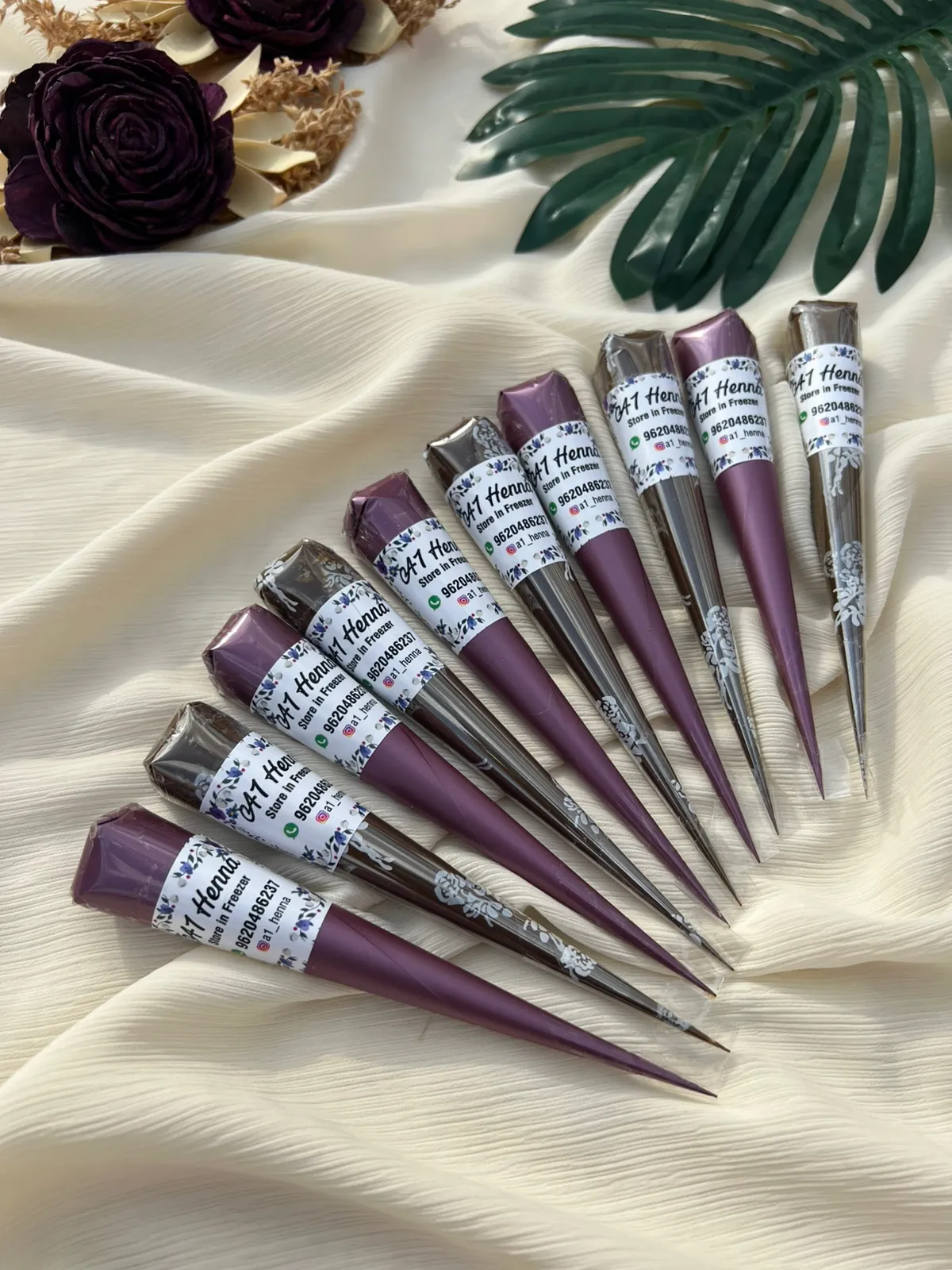 Henna ConesOrganic Henna ConesOrganic henna paste * Rich, natural henna stain * Halal · No PPD * Fine tip for detailed designs * Freshly hand-rolled in Bengaluru₹30View product →
Why that matters more than it sounds
Paste consistency isn't uniform the way a factory process assumes it should be — henna powder varies batch to batch depending on the harvest, and a mix that's slightly too thick or thin genuinely changes how well it stains. Hand-mixing means I can feel that variation and adjust before it ever reaches someone's hands, the same way I teach students to check consistency in how to make henna paste at home. A machine calibrated for "average" paste doesn't catch that — it just keeps producing.
The tip is where most bought cones actually fail
A cone that leaks, blobs or won't hold a fine line ruins a design regardless of how good the henna inside it is. Hand-rolling lets me control the twist and seal at the tip precisely, cone by cone — something I go into more practically in how to roll a henna cone for students who want to learn the skill themselves. It's a small thing that makes an enormous difference the moment someone actually starts drawing.
The real trade-off: speed for standard
I won't pretend hand-rolling is the faster or cheaper way to do this. A machine line could push out cones far quicker and probably at a lower cost per unit. What it can't do is let one person actually feel whether today's batch of paste is right before it goes out the door. I've chosen the slower way on purpose, every time this decision has come up.
See the cones this process actually makes →
Small batches mean fresh batches
Hand-rolling naturally keeps batch sizes small, and that's a feature, not a limitation — it means we're not sitting on months of stock losing staining power on a shelf. Lawsone, the dye in henna, degrades with heat and time; a cone rolled last week and one rolled six months ago are not the same product even if the label looks identical. See henna cone shelf life & storage for exactly why that matters.
What a rolling session actually looks like
It's not glamorous. Powder gets sifted and checked, paste is mixed and rested until a test smear on my palm goes properly orange within a minute, and then it's cone after cone — fill, twist, seal, tip cut to the same fine width, dated, packed. A full session can take hours for what looks like a simple product once it's in a box. I've had people assume "hand-rolled" is a nice-sounding phrase for something that's basically automated with a bit of finishing touch by hand — it isn't. It's the whole process, start to finish, done by someone paying attention the entire time.
What I've taught students about this
Every woman who comes through a Hennaya training batch learns to roll her own cones for exactly this reason — not because buying pre-made is wrong, but because understanding what a good cone actually requires makes her a better judge of quality, whether she's rolling her own or buying someone else's. I write more about what the batches actually cover in why I train women to become henna professionals.
Will this ever change?
Maybe the studio grows, maybe the team grows with it — but the standard won't. Whoever rolls a Hennaya cone, whether it's me or someone I've trained to the exact same process, it gets checked, felt, and sealed by a person who knows what a good cone is supposed to feel like. That's not something I'm willing to hand over to a machine, no matter how much faster it would be.
What buying a hand-rolled cone actually gets you
Beyond the sentiment, there's a practical payoff: consistency you can rely on booking after booking, a fine tip that doesn't fight you mid-design, and a batch date so you're never guessing how fresh what you bought actually is. Those are small things individually, but they're the difference between a stain you're proud of and one you're disappointed by two days later — and they're exactly what a rushed, machine-scaled process is most likely to sacrifice first.
Where I've had to compromise, and where I haven't
I'm not precious about everything — packaging design, shipping partners, the website itself have all changed and improved over time without a second thought. The paste recipe and the hand-rolling process are the two things I've never let anyone talk me into shortcutting, even when it would have been cheaper or faster to do so. Everything else in this business can evolve; those two things are the actual product, and they stay exactly as careful as they were on day one. I'd rather turn down an order I can't fulfil fresh than send out something rolled in a rush just to keep a delivery date.
Every cone we sell still gets the same hands-on check the very first one did — that's not changing, however big this gets.
Questions people ask
Are Hennaya's cones machine-made or hand-rolled?
Hand-rolled, in small batches, every time — not mass-produced on a machine line. Each cone is filled, twisted and sealed by hand.
Does hand-rolling actually change the quality of the stain?
Indirectly, yes — hand-rolling lets us catch a bad batch of paste before it ships, control the tip for a fine even line, and keep every batch small enough to sell fresh instead of sitting in a warehouse.
Why not switch to machine production to scale faster?
Because quality control at that scale gets harder, not easier, and freshness is the one thing I refuse to compromise on — even if it means the business grows more slowly.
How fresh are the cones when they're delivered?
Rolled to order in small batches from our BTM 1st Stage studio, with same-day delivery across Bangalore and dispatch across India — never sitting in storage for months before it reaches you.
Keep reading
Why I Train Women to Become Henna Professionals
Aliya on why teaching became as important as the art itself — turning a skill women already love into a real, confident income, one 20-day batch at a time.
My Vision for Hennaya: Where This Is Headed
Aliya on what she's actually building — not just a henna shop, but a studio, a training ground and a livelihood path for women in Bangalore, and where it goes next.
Why I Started Rolling My Own Henna Cones
Aliya on the real reason Hennaya's cones exist — she couldn't reliably buy henna she'd trust on a bride's hands, so she started rolling her own from scratch.